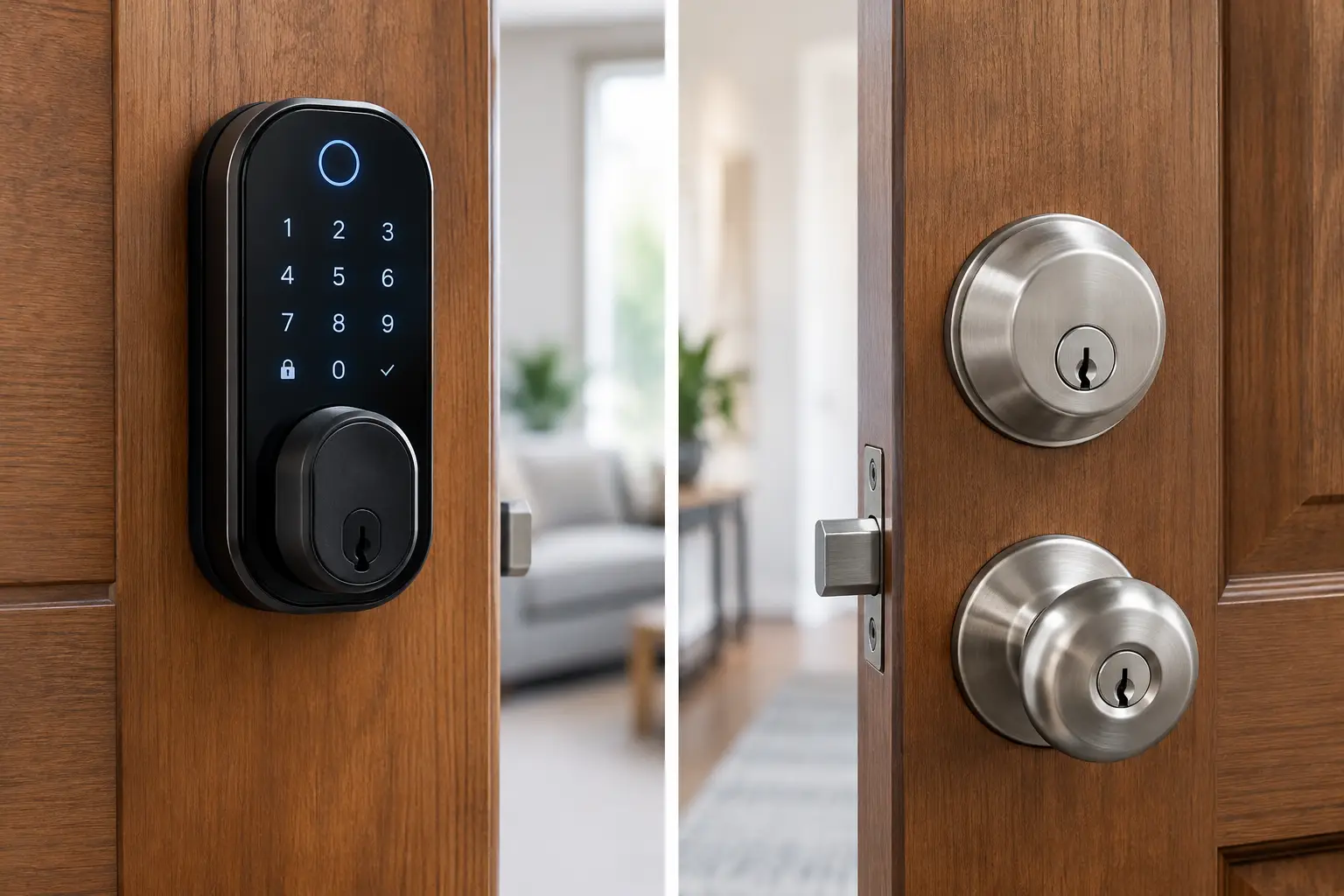

A front door lock has one job: keep the wrong people out while letting the right people in without a struggle. The smart lock vs deadbolt decision matters because convenience should never come at the expense of physical security – especially for Bay Area homes, rental properties, offices, and storefronts.
A smart lock can make daily access easier with codes, phone control, and activity alerts. A traditional deadbolt remains a proven, straightforward barrier that works without batteries, Wi-Fi, or an app. Neither option is automatically right for every door. The best choice depends on the lock’s quality, the door and frame behind it, who needs access, and how you plan to handle emergencies.
Smart Lock vs Deadbolt: The Main Difference
A traditional deadbolt is a mechanical lock. Turning a key or thumb turn moves a solid metal bolt into the door frame. Its strength comes from simple, physical construction. When properly installed with a reinforced strike plate and long screws anchored into the wall framing, a quality deadbolt is difficult to force open.
A smart lock adds electronic access control. Depending on the model, you may open it with a keypad code, smartphone app, fingerprint reader, key fob, or voice assistant. Many smart locks still use a physical deadbolt bolt. In those cases, the device is not replacing the deadbolt’s basic security function. It is changing how the bolt is operated and who can be granted access.
That distinction is critical. A cheap smart lock with weak hardware is not a security upgrade simply because it has an app. Likewise, an excellent deadbolt installed in a weak door frame cannot perform at its best. Security is always a system, not just the lock on the door.
When a Traditional Deadbolt Is the Better Choice
A standard deadbolt is often the right answer for homeowners and business owners who want dependable protection with minimal moving parts. It has no battery to replace, no internet connection to troubleshoot, and no digital account that needs to be managed.
For a side door, storage room, detached garage, or low-traffic entry, a quality Grade 1 or Grade 2 deadbolt can be a practical, durable choice. Mechanical deadbolts also work well for people who prefer physical keys and do not want their security tied to a phone.
Deadbolts are usually less expensive upfront, but the true value is reliability. After a power outage, a deadbolt still operates normally. A keyed deadbolt does not care whether your Wi-Fi is down, whether a software update failed, or whether someone forgot to charge a phone.
There are trade-offs. Keys can be lost, copied, stolen, or left with former tenants, employees, contractors, or guests. If control over keys is uncertain, rekeying or replacing the lock should be handled promptly. For a rental property or business with frequent staff changes, managing keys can become a recurring security issue.
Deadbolt security depends on installation
A deadbolt is only as strong as the door, strike plate, screws, and surrounding frame. A lock may resist picking or drilling, yet a forced kick can still split an unreinforced frame. Proper installation matters just as much as the brand on the box.
A professional locksmith can evaluate whether the existing hardware is aligned correctly, whether the bolt fully enters the strike plate, and whether the door frame needs reinforcement. This is especially valuable in older San Francisco and Daly City properties, where doors may have settled over time or received multiple repairs.
When a Smart Lock Makes More Sense
Smart locks are built for access control. They are a strong fit when several people need entry but you do not want permanent copies of a key circulating.
A homeowner can assign a temporary code to a dog walker, house cleaner, or visiting family member, then remove it when it is no longer needed. A property manager can change access between tenants without collecting every old key. A small business owner can issue individual codes to employees and review access activity on supported models.
That control can be more than convenient. It can reduce uncertainty. If an employee leaves or a contractor finishes work, deleting a code takes seconds. With a conventional key system, the safer response may be to rekey the lock.
Smart locks can also help in common daily situations. You may arrive home carrying groceries, need to let in a guest while you are away, or want an alert when a child gets home from school. For busy households and managed properties, those features have real value.
Smart locks require a backup plan
Electronic locks need power. Most run on batteries and warn you when the battery level is low, but warnings should not be ignored. A dead battery can leave you standing outside at the worst possible time.
Choose a model with a dependable backup option, such as a physical keyway or emergency external power connection. Keep any backup key accessible without hiding it in an obvious location near the door. If the lock relies on an app, make sure you understand whether it still works locally when internet service is interrupted.
For commercial doors, compatibility matters even more. Fire-rated doors, panic hardware, door closers, access regulations, and high-volume use can limit which smart locks are appropriate. Do not install consumer hardware on a commercial entry just because it looks convenient. The wrong product can create safety, compliance, and reliability problems.
Is a Smart Lock Less Secure Than a Deadbolt?
Not necessarily. A quality smart deadbolt can provide physical protection comparable to a quality traditional deadbolt, provided it is installed correctly. The question is not simply whether the lock is electronic. The question is whether its mechanical construction, access controls, and installation are appropriate for the door.
Smart locks add potential digital risks, including weak account passwords, shared login credentials, outdated software, and unnecessary remote-access permissions. Those risks are manageable when the lock is configured carefully. Use a unique, strong account password, enable two-factor authentication when available, remove old users promptly, and keep the lock’s software current.
Traditional deadbolts have their own risks. A copied key may go unnoticed for years. Someone can retain a key after moving out, changing jobs, or completing a repair. A key control problem is often invisible until it becomes an access problem.
For many properties, the strongest approach is not smart lock or deadbolt. It is a smart deadbolt with a physical key backup, installed on a solid door with reinforced hardware. That gives you controlled access without abandoning a proven mechanical locking method.
Cost, Maintenance, and Emergency Access
A traditional deadbolt usually costs less to purchase and has lower ongoing maintenance. It may need occasional lubrication, adjustment, repair, or rekeying, but it does not require batteries or account management.
A smart lock costs more upfront and requires regular battery checks. It may also need occasional troubleshooting when a phone changes, an app updates, or connectivity drops. Before purchasing, confirm that the lock fits your door thickness, backset, handedness, and existing bore holes. A lock that is not compatible can create a poor fit, unreliable operation, or unnecessary damage during installation.
Emergency access deserves serious thought. If you lose a house key, a locksmith can open the door and rekey or replace the lock without damaging the door whenever conditions allow. If a smart lock fails, the solution depends on its backup method and the nature of the failure. A qualified locksmith can diagnose mechanical alignment issues, damaged parts, failed key cylinders, and many common access problems on-site.
Avoid treating a lockout as a reason to force the door, drill hardware immediately, or break a window. Those actions can create far more expensive damage than the original problem.
How to Choose the Right Lock for Your Property
Start with how the door is used. A primary residence with frequent visitors may benefit from codes and remote management. A quiet back door may need only a high-quality mechanical deadbolt. A rental property may require easy code changes between occupants. An office may need a more complete commercial access-control solution rather than a residential smart lock.
Then consider the condition of the opening itself. Check for loose hinges, gaps around the door, a shallow strike plate, soft or damaged wood, and a bolt that does not extend smoothly. Fixing these issues can make a greater security difference than adding more features.
Finally, choose hardware that is built for security, not just convenience. Look for recognized security ratings, solid construction, reliable backup access, and a manufacturer with ongoing product support. A professional installation helps ensure the lock, door, frame, and strike hardware work together as intended.
If you are upgrading an entry, replacing worn hardware, or worried that old keys are still in circulation, do not wait for a lockout or break-in scare. YES Locksmith can assess your door hardware, install the right lock for the job, and help protect your property without unnecessary damage. The right lock should give you confidence every time the door closes.