
That small snap you hear when a key breaks is enough to stop your whole day. A broken key in lock can leave you stuck outside your house, stranded next to your car, or unable to secure a business at the worst possible time. The next few minutes matter, because the wrong move can turn a simple extraction into a damaged lock, a bent cylinder, or a full replacement.
When people panic, they usually do one of two things. They jam the broken piece farther in, or they start digging at it with whatever is nearby. Both can make the situation worse. If the goal is getting back in quickly without damaging the lock, a calm and careful response is the safest path.
What causes a broken key in lock
Keys rarely break for no reason. In most cases, the key has been weakening for a while, or the lock has been getting harder to operate and no one had time to deal with it. Metal fatigue is common, especially with older keys that have been copied multiple times. Each duplicate can lose a little precision, and that poor fit adds extra stress every time the key turns.
The lock itself may also be part of the problem. Dirt inside the cylinder, worn pins, rust, poor alignment, or internal damage can all create resistance. That resistance forces people to twist harder than they should. In homes, this often happens with aging front door hardware or side gates exposed to weather. In cars, it may show up on older ignitions or door locks. In commercial buildings, heavy daily use can wear locks down faster than most owners expect.
Cold weather, moisture, and simple wear all add up. If the key was already thin, cracked, or bent, it may only take one hard turn for it to snap.
First steps when a broken key is stuck in the lock
Start by stopping. Do not insert the remaining half of the key back into the lock to try to “catch” the broken piece. Do not force the lock to turn. If the cylinder is under pressure, even a small push can wedge the fragment deeper.
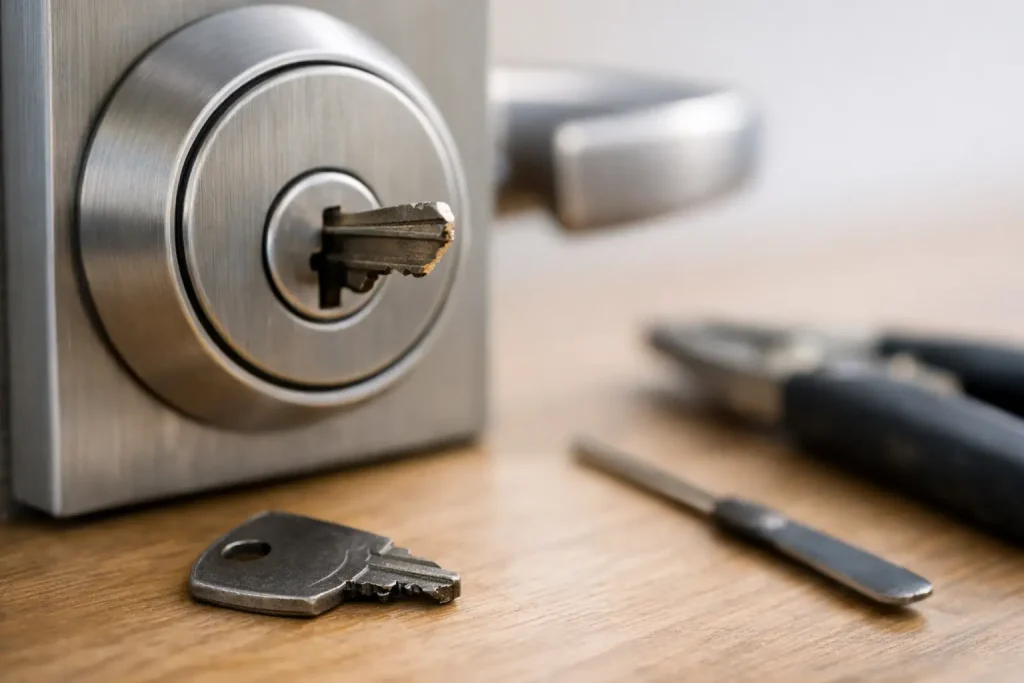
Take a close look at the keyway. If part of the broken key is clearly sticking out, you may have a small window to remove it safely. If it is flush with the face of the lock or buried deeper inside, your odds of a clean DIY fix drop fast.
If this is a door, check whether the lock is in a neutral position. Sometimes the key breaks while the plug is slightly turned. If the lock is twisted off-center, extraction gets harder and the broken piece can bind inside. The same is true for many vehicle locks.
Good lighting helps. So does patience. What you are trying to avoid is turning a simple extraction into internal lock damage.
When you can try removing it yourself
A do-it-yourself attempt only makes sense when a small portion of the key is visible and you can work carefully without forcing anything. Needle-nose tweezers usually do not work well unless enough of the key is exposed to grip. In many cases, tweezers actually push the fragment farther in.
A broken key extractor tool is the right option, but most people do not have one on hand. If you do, insert it gently alongside the key fragment, hook the cuts on the key, and pull straight out. A light lubricant made for locks may help, but avoid soaking the cylinder or using the wrong product. Too much lubricant can attract grime or interfere with the lock over time.
If the key does not move with light pressure, stop there. This is where many property owners and drivers turn a minor service call into a lock repair job. One aggressive attempt with a paper clip, knife tip, screwdriver, or bobby pin can scratch internal components or snap another object inside the lock.
What not to do with a broken key in lock
The biggest mistake is treating the lock like a simple mechanical slot. It is not. Modern residential, commercial, and automotive locks have precise internal parts, and they do not respond well to improvised tools.
Do not use super glue. People try this more often than they admit, hoping to bond the broken key to the piece still stuck inside. In real situations, glue tends to spread onto the face of the lock or inside the keyway. Once that happens, extraction becomes more difficult and replacement is more likely.
Do not hammer, drill, or pry unless you are prepared to replace the hardware. Drilling a lock may sound like a quick fix, but it is usually the last resort, not the first. A trained locksmith will almost always try nondestructive methods before recommending replacement.
Do not keep twisting the lock if any part of the key is still inside. That can damage the plug, pins, wafers, or ignition components. In a vehicle, forcing the issue can create a much more expensive repair.
Why professional extraction is usually the cheaper option
A lot of customers delay calling because they assume a locksmith visit will cost more than handling it themselves. In practice, the opposite is often true. If the broken key is removed cleanly, the existing lock may stay usable. If the lock is damaged during a DIY attempt, you may be paying for extraction, repair, and replacement hardware on top of the original problem.
A professional locksmith has extraction tools designed for this exact situation. More importantly, an experienced technician can tell whether the lock itself caused the break. That matters. If the lock is binding, misaligned, or worn out, removing the key is only half the job. The real fix is making sure it does not happen again next week.
This is especially important for storefronts, office doors, apartment units, and busy entry points. If an employee key breaks because the cylinder is failing, that is not just an inconvenience. It is a security and access problem that can interrupt business.
Residential, automotive, and commercial situations are different
Home locks tend to give some warning before a key breaks. The key may stick, require jiggling, or feel rough on the turn. If a broken key gets stuck in a house lock, a locksmith can often extract it on-site and determine whether the lock should be repaired, rekeyed, or replaced.
Vehicle situations can be more sensitive. Car door locks and ignitions may have tighter tolerances, and newer systems can involve transponder keys, laser-cut keys, or ignition components that are expensive to damage. If a car key breaks in the door or ignition, it makes sense to stop immediately and let a trained mobile locksmith handle it where the vehicle is parked.
Commercial locks bring another layer of urgency. A broken key in lock at a retail storefront, office suite, gate, or interior business door can affect employees, deliveries, tenant access, and building security. In these cases, speed matters, but so does preserving the hardware when possible. Master key systems, restricted keyways, and commercial-grade cylinders need a technician who understands more than basic extraction.
Signs the lock needs more than key removal
Sometimes the broken key is the symptom, not the whole problem. If the lock was already sticking, if you have had repeated issues with copied keys, or if the door has to be pushed or pulled hard to latch, the hardware needs attention.
Watch for rough turning, visible wear on keys, loose lock cylinders, keys that only work when wiggled, or doors that are out of alignment. For businesses and rental properties, those signs should not be ignored. A lock that is fighting the key today can fail completely at the worst possible time.
In many cases, a locksmith can correct the issue without replacing every part. Rekeying, cylinder service, realignment, or selective hardware replacement may be enough. It depends on the age of the lock, the level of wear, and whether security needs have changed.
How to reduce the chance of it happening again
The simplest prevention is paying attention to warning signs. If a key is bent, cracked, or worn thin, replace it before it snaps. If a lock starts feeling stiff, have it serviced before it becomes an emergency. This is particularly worthwhile for front doors, rental units, office entries, gates, and older vehicle locks that see frequent use.
Use properly cut keys. Low-quality duplicates can create fit issues that slowly wear both the key and the lock. Keep locks clean and professionally maintained when needed. And if a door is out of alignment, fix that too, because no lock performs well when the hardware is under constant pressure.
When a broken key catches you off guard, what matters most is avoiding extra damage and getting the problem handled correctly the first time. For urgent situations in San Francisco, Daly City, and nearby Bay Area communities, YES Locksmith provides mobile service that comes to you, extracts broken keys carefully, and helps make sure the lock is still safe and reliable after the immediate crisis is over.
A broken key can feel like a small disaster when you are standing outside, late for work, or trying to secure a property after hours. The good news is that this problem is usually fixable without major damage if it is handled the right way, right away.